


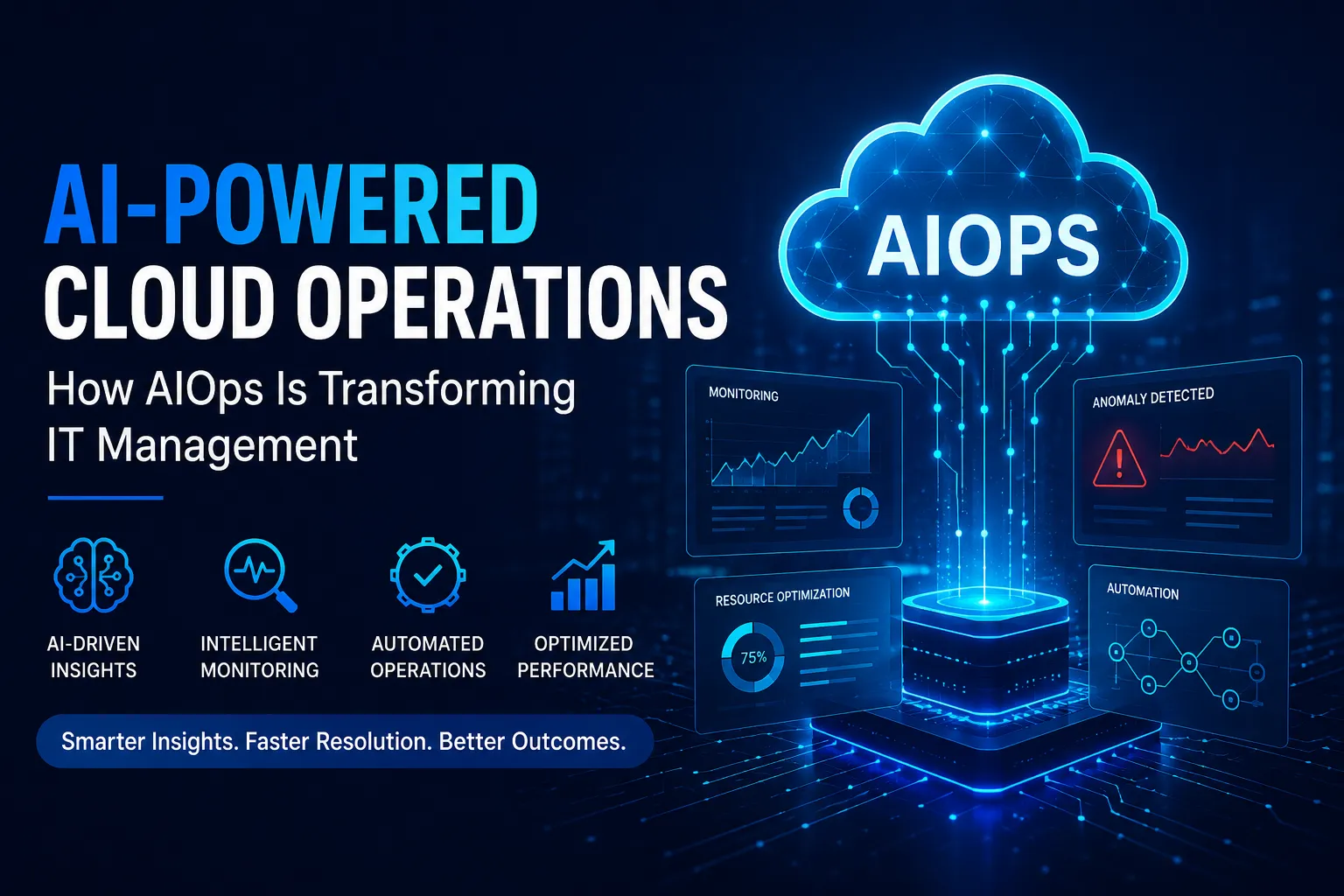
AI-Powered Cloud Operations: How AIOps Is Transforming IT Management in 2026
Introduction
As organizations accelerate their digital transformation initiatives, cloud environments are becoming increasingly complex. Modern businesses operate across multi-cloud platforms, hybrid infrastructures, containerized applications, microservices, and distributed workloads. While these advancements enable greater agility and scalability, they also create significant operational challenges for IT teams.
Traditional monitoring and management approaches often struggle to keep pace with the volume of data, alerts, and performance metrics generated by today's cloud ecosystems. This is where Artificial Intelligence for IT Operations (AIOps) is reshaping the future of cloud management.
By combining artificial intelligence, machine learning, big data analytics, and automation, AIOps empowers organizations to proactively manage cloud infrastructure, improve operational efficiency, and deliver better business outcomes.
In 2026, AIOps is no longer an emerging technology—it's becoming a strategic necessity for organizations seeking to optimize cloud performance, reduce downtime, and enhance customer experiences.
What Is AIOps?
AIOps, or Artificial Intelligence for IT Operations, refers to the use of AI and machine learning technologies to automate and enhance IT operations.
AIOps platforms continuously collect and analyze vast amounts of operational data from:
- Cloud infrastructure
- Applications
- Networks
- Security systems
- Databases
- Containers and Kubernetes environments
By identifying patterns, anomalies, and correlations within this data, AIOps helps organizations detect issues faster, automate responses, and predict potential failures before they impact business operations.
Why Traditional IT Operations Are No Longer Enough
Modern cloud environments generate millions of events and alerts every day. IT teams often face challenges such as:
Alert Fatigue
Operations teams are overwhelmed by thousands of notifications, making it difficult to identify critical issues.
Increasing Infrastructure Complexity
Organizations now manage resources across multiple cloud providers, SaaS applications, and hybrid environments.
Slow Incident Resolution
Manual troubleshooting processes consume valuable time and often delay recovery efforts.
Limited Visibility
Traditional monitoring tools typically provide isolated views rather than a unified understanding of system health.
As cloud ecosystems continue to expand, businesses require smarter solutions that can process data at scale and provide actionable insights in real time.
How AIOps Works
AIOps platforms follow a continuous cycle of data collection, analysis, prediction, and automation.
Data Aggregation
Operational data is collected from various sources, including:
- Cloud platforms
- Application logs
- Network devices
- Performance monitoring tools
- Security systems
Machine Learning Analysis
AI models analyze historical and real-time data to identify:
- Performance anomalies
- Resource bottlenecks
- Security threats
- Service disruptions
Intelligent Correlation
Instead of displaying thousands of separate alerts, AIOps correlates related events into a single incident, helping teams quickly identify root causes.
Automated Remediation
When predefined conditions are met, AIOps platforms can automatically:
- Restart services
- Scale infrastructure
- Allocate resources
- Trigger incident response workflows
This reduces manual intervention and accelerates issue resolution.
Key Benefits of AI-Powered Cloud Operations
1. Faster Incident Detection and Resolution
One of the biggest advantages of AIOps is its ability to detect issues before they escalate.
Machine learning algorithms continuously monitor system behavior and identify abnormalities that may indicate future failures.
Benefits include:
- Reduced Mean Time to Detect (MTTD)
- Reduced Mean Time to Resolve (MTTR)
- Improved service availability
- Enhanced customer experiences
2. Predictive Infrastructure Management
Traditional monitoring focuses on what has already happened.
AIOps shifts operations toward predictive management by forecasting:
- Resource shortages
- Application failures
- Capacity limitations
- Performance degradation
This proactive approach allows organizations to address issues before users experience disruptions.
3. Intelligent Monitoring Across Cloud Environments
Modern enterprises often operate in multi-cloud environments using platforms such as AWS, Azure, and Google Cloud.
AIOps provides centralized visibility across these environments by:
- Consolidating monitoring data
- Eliminating operational silos
- Delivering unified dashboards
- Simplifying cloud governance
This enables teams to manage complex infrastructures more effectively.
4. Automated Cloud Operations
Automation is at the core of AIOps.
Routine operational tasks that previously required manual effort can now be executed automatically.
Examples include:
- Auto-scaling cloud resources
- Performance optimization
- Service restarts
- Backup verification
- Security policy enforcement
Automation not only improves efficiency but also reduces human error.
5. Enhanced Cost Optimization
Cloud cost management remains a top priority for businesses.
AIOps helps optimize spending by identifying:
- Underutilized resources
- Idle virtual machines
- Unnecessary storage allocations
- Overprovisioned infrastructure
Organizations can improve resource utilization while controlling operational expenses.
The Role of AIOps in Cloud Security
Cybersecurity threats continue to evolve rapidly, making real-time threat detection essential.
AIOps strengthens cloud security through:
Behavioral Analysis
AI can establish baseline activity patterns and detect unusual behavior that may indicate security incidents.
Threat Detection
Machine learning algorithms identify suspicious activities faster than traditional rule-based systems.
Automated Response
When threats are detected, automated workflows can initiate containment measures, reducing potential damage.
Continuous Compliance Monitoring
AIOps helps organizations maintain compliance by identifying configuration drift and policy violations across cloud environments.
AIOps and DevOps: A Powerful Combination
DevOps has transformed software delivery by improving collaboration between development and operations teams.
AIOps complements DevOps by providing:
- Real-time operational insights
- Automated incident management
- Predictive analytics
- Continuous performance optimization
Together, DevOps and AIOps enable organizations to deliver applications faster while maintaining reliability and performance.
Real-World Applications of AIOps
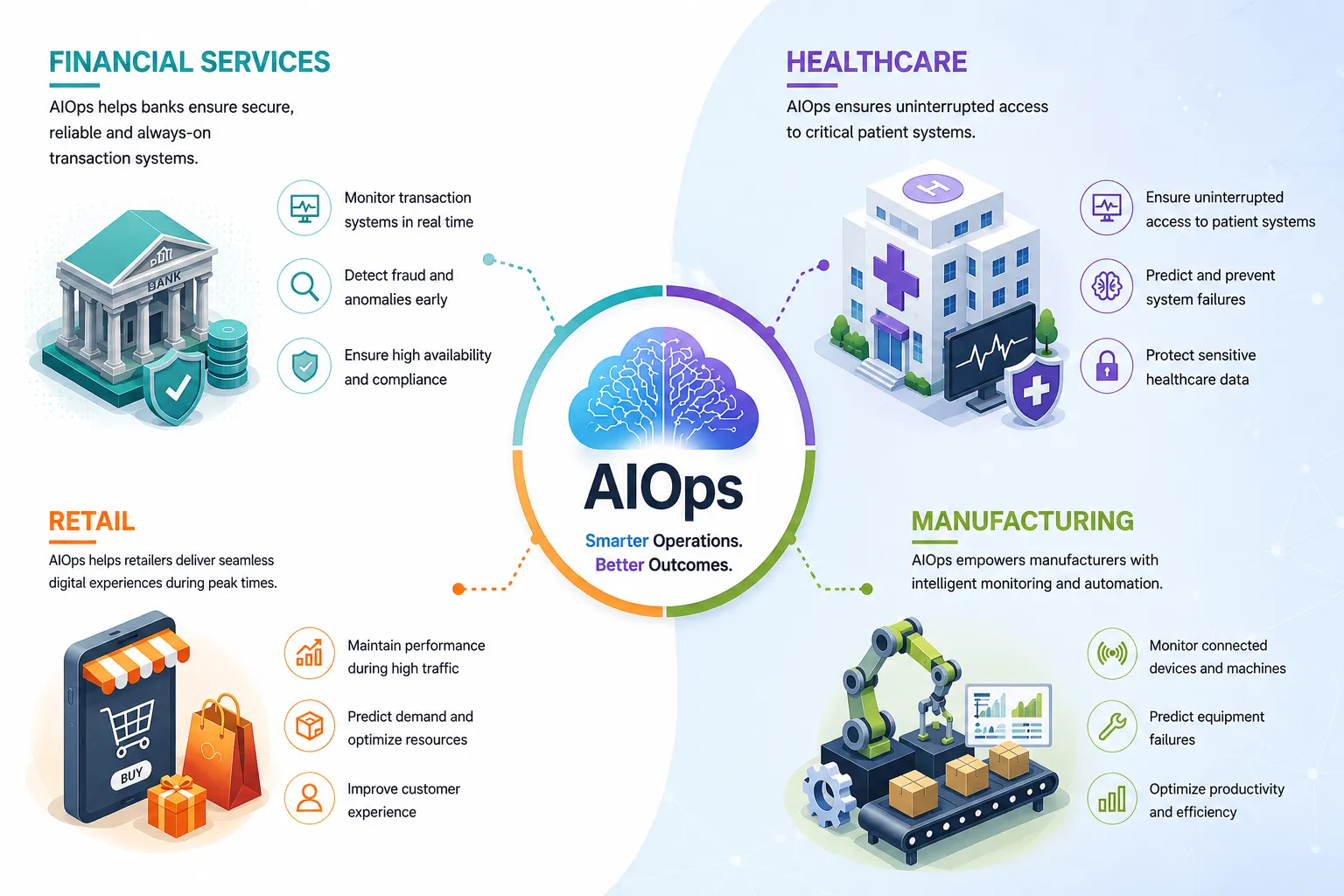
Organizations across industries are leveraging AIOps to improve operations.
Financial Services
Banks use AIOps to monitor transaction systems, detect anomalies, and maintain service availability.
Healthcare
Healthcare providers rely on AIOps to ensure uninterrupted access to critical patient systems and applications.
Retail
Retail organizations use predictive analytics to maintain website performance during high-traffic shopping periods.
Manufacturing
Manufacturers leverage AIOps to monitor connected devices and optimize operational efficiency.
Challenges Organizations Must Address
While AIOps offers significant benefits, successful implementation requires careful planning.
Common challenges include:
Data Quality Issues
AI models depend on accurate and consistent data sources.
Integration Complexity
Organizations often need to connect multiple monitoring and operational platforms.
Skills Gap
Teams may require training to effectively manage AI-driven operations.
Governance Requirements
Clear policies must be established to ensure automation aligns with business objectives and compliance requirements.
Addressing these challenges helps maximize the value of AIOps investments.
The Future of AIOps
As AI technology continues to mature, AIOps capabilities will become even more sophisticated.
Emerging trends include:
Generative AI for Operations
AI assistants will help teams troubleshoot incidents, generate recommendations, and automate workflows using natural language interactions.
Autonomous Cloud Management
Future platforms will automatically optimize infrastructure with minimal human intervention.
Advanced Predictive Analytics
Organizations will gain deeper insights into future operational risks and business impacts.
Hyperautomation
AIOps will increasingly integrate with broader business processes, creating end-to-end automation across the enterprise.
Why Businesses Should Invest in AIOps Today
Organizations that adopt AIOps gain significant advantages:
- Improved operational efficiency
- Reduced downtime
- Faster incident resolution
- Enhanced security posture
- Better customer experiences
- Lower cloud operating costs
- Increased business agility
As cloud environments continue to grow in scale and complexity, AI-powered operations will become essential for maintaining performance, reliability, and competitiveness.
Conclusion
The future of IT management lies in intelligent, automated, and proactive operations. AIOps is transforming how organizations monitor, manage, and optimize cloud environments by leveraging artificial intelligence, machine learning, and automation.
Rather than reacting to issues after they occur, businesses can now predict problems, automate resolutions, and continuously improve performance across their cloud infrastructure.
Organizations that embrace AI-powered cloud operations today will be better equipped to handle tomorrow's challenges, accelerate innovation, and achieve sustainable growth in an increasingly digital world.
At Cloud TechOn, we help businesses modernize their cloud operations through AI-driven monitoring, automation, cloud optimization, and managed services. Contact our experts to discover how AIOps can improve your cloud performance, security, and operational efficiency.