


Lift-and-Shift vs Cloud-Native Migration: Which Is Better?
Introduction
As businesses accelerate their digital transformation journey, cloud migration has become a top priority. But one critical question continues to challenge organizations:
Should you choose Lift-and-Shift migration or go fully Cloud-Native?
Both approaches offer unique advantages depending on your business goals, budget, timeline, and application architecture. Understanding the differences can help organizations avoid costly mistakes and maximize cloud ROI.
In this article, we’ll break down:
- What Lift-and-Shift means
- What Cloud-Native migration involves
- Key differences
- Pros and cons
- Which strategy works best for different business needs
What Is Lift-and-Shift Migration?
Lift-and-Shift, also known as Rehosting, is the process of moving applications from on-premises infrastructure to the cloud with minimal or no changes to the application architecture.
Think of it as:
“Move first, optimize later.”
How It Works
- Existing applications are migrated directly to cloud infrastructure
- Minimal code modifications
- Faster migration timelines
- Applications continue functioning similarly to on-premise environments
Common AWS Services Used
- Amazon EC2
- Amazon RDS
- AWS Application Migration Service
- Amazon EBS
- Elastic Load Balancer
Benefits of Lift-and-Shift Migration
✅ Faster Cloud Adoption
Organizations can migrate workloads quickly without rebuilding applications.
✅ Lower Initial Costs
Minimal redevelopment reduces upfront investment.
✅ Reduced Migration Risk
Applications remain mostly unchanged, lowering operational disruption.
✅ Quick Business Continuity
Ideal for companies needing immediate scalability or data center exit strategies.
Challenges of Lift-and-Shift
❌ Limited Cloud Optimization
Applications may not fully utilize cloud-native capabilities.
❌ Higher Long-Term Costs
Unoptimized workloads can increase cloud spending over time.
❌ Scalability Limitations
Legacy architectures may struggle with modern scalability demands.
❌ Technical Debt Remains
Old infrastructure inefficiencies often move into the cloud unchanged.
What Is Cloud-Native Migration?
Cloud-Native migration involves redesigning or rebuilding applications specifically for cloud environments.
This strategy focuses on:
- Microservices architecture
- Containers
- Serverless computing
- Automation
- Scalability
- Resilience
Instead of simply moving applications, businesses modernize them to fully leverage cloud capabilities.
Benefits of Cloud-Native Migration
✅ Maximum Scalability
Applications can scale dynamically based on demand.
✅ Better Performance
Cloud-native apps are optimized for speed, resilience, and availability.
✅ Cost Optimization
Efficient resource utilization helps reduce infrastructure costs.
✅ Faster Innovation
Teams can deploy updates rapidly using DevOps and CI/CD pipelines.
✅ Improved Security & Reliability
Modern architectures improve fault tolerance and disaster recovery.
Challenges of Cloud-Native Migration
❌ Higher Initial Investment
Requires redesign, redevelopment, and skilled cloud expertise.
❌ Longer Migration Timelines
Application modernization takes more time than rehosting.
❌ Operational Complexity
Managing containers, Kubernetes, and microservices requires advanced knowledge.
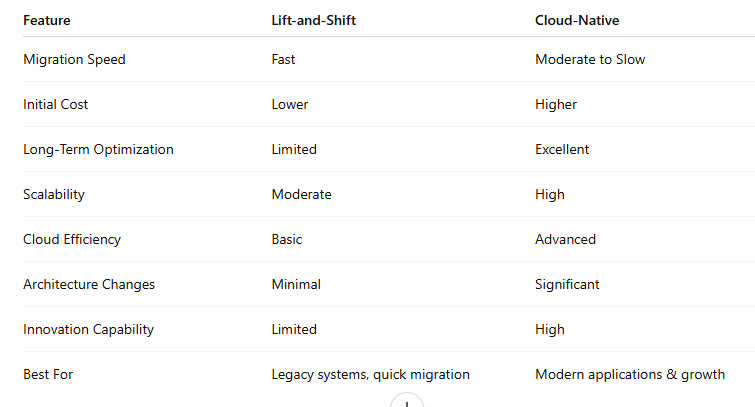
Lift-and-Shift vs Cloud-Native: Key Differences
Which Migration Strategy Is Better?
The answer depends entirely on your business objectives.
Choose Lift-and-Shift If:
- You need rapid cloud migration
- Your applications are stable legacy systems
- You have limited migration budgets
- You want to exit physical data centers quickly
- Downtime must be minimized
Choose Cloud-Native If:
- You want long-term scalability
- Innovation and agility are priorities
- Your business plans rapid growth
- You need modern DevOps automation
- You want better cloud cost efficiency over time
The Hybrid Approach: Best of Both Worlds
Many enterprises today adopt a hybrid migration strategy.
Phase 1:
Use Lift-and-Shift for immediate cloud adoption.
Phase 2:
Gradually modernize applications into cloud-native architectures.
This approach reduces risk while enabling long-term cloud transformation.
How AWS Supports Both Migration Models
AWS provides powerful tools for both strategies.
For Lift-and-Shift:
- AWS Application Migration Service
- Amazon EC2
- AWS Database Migration Service
- AWS Migration Hub
For Cloud-Native:
- Amazon EKS
- AWS Lambda
- Amazon ECS
- AWS Fargate
- Amazon Bedrock
- AWS DevOps Tools
Final Thoughts
There is no one-size-fits-all migration strategy.
Lift-and-Shift offers speed and simplicity, while Cloud-Native delivers long-term innovation, scalability, and efficiency.
The best approach is the one that aligns with your:
- Business goals
- Budget
- Application complexity
- Growth plans
- Operational capabilities
Organizations that strategically combine both models often achieve the best balance between rapid migration and future-ready cloud transformation.
How Cloud TechOn Can Help
At Cloud TechOn, we help businesses:
- Assess cloud readiness
- Design AWS migration strategies
- Optimize cloud costs
- Modernize applications
- Build scalable cloud-native environments
Whether you're planning a quick migration or a full cloud transformation, our AWS experts can guide your journey every step of the way.
#AWS #CloudMigration #CloudNative #LiftAndShift #AWSServices #DigitalTransformation #CloudComputing #DevOps #Kubernetes #Serverless #AWSCloud #CloudStrategy